



One of the main aims is to create and coordinate a team of scientists and experts to address the challenges in the field of environmental nano- and microplastic pollution
The infographic illustrates the organization of the PRIORITY COST Action, which brings together a multidisciplinary network of scientists and experts to address the global challenge of nano- and microplastic (N/MP) pollution.
The Action is structured into seven interconnected Working Groups (WGs), each focusing on a specific aspect of the problem, yet closely linked through shared objectives and collaborative activities.
The graphic representation highlights the dynamic interplay among WGs, where knowledge flows from fundamental understanding and measurement (WG1–4), through methodological and technological standardization (WG6), toward societal awareness and sustainable innovation (WG5 and WG7).
By entering in each dedicated section of the WG you will find regular update of individual Working Groups (WGs) Activities. You can also find here a Report for WG activities with all the relevant links.
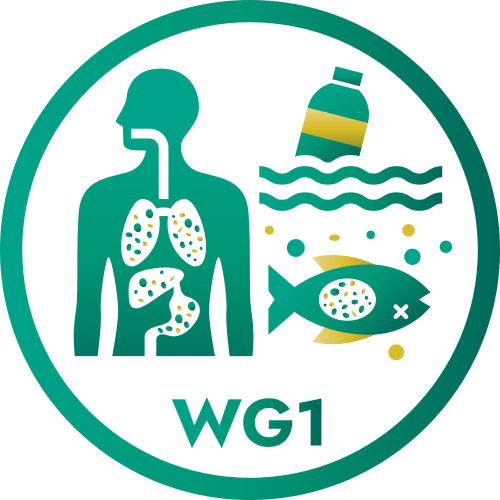
WG1 aims to assess impacts and risks on human health and environment related to N/MPs, as well as to identify, develop and increase the European and global standardization of methods for testing the hazards of N/MPs.
WG2 aims to help European and developing countries to assess and develop harmonized monitoring methods and sampling procedures for different environmental matrices.
The objectives of WG3 are to (1) understand the potential of the tools available for the analysis, (2) to help European and developing countries to assess harmonized methods, and (3) to facilitate and encourage access to EU research infrastructures and facilities.
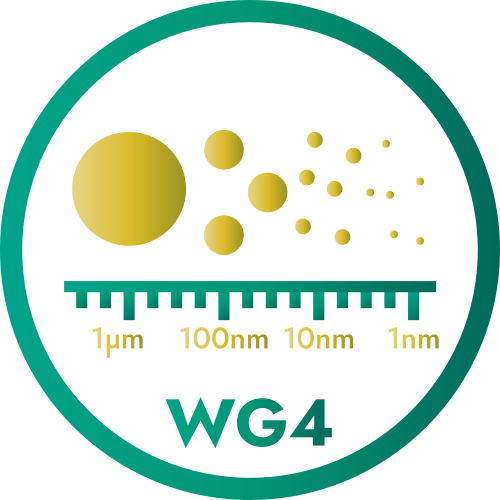
WG4 aims to identify suitable and validated analytical methods for detection and quantification of NPs based on the experiences of the Action participants.
WG5 – Remediation, recovery and development of sustainable alternative to plastic materials- aims to identify reuse, recycling, and recovery alternatives for environmental plastics and to define technological approaches for new recycling and recovery alternatives.
The main objectives of this WG are the validation of existing protocols for sample preparation and measurements (shape, size, abundance, and composition) in the range of N/MPs, through organization and the participation of PRIORITY laboratories in interlaboratory studies and comparison with different independent measurement principles.
This WG plans to encourage scientists to participate in science communication activities to increase awareness in society and education regarding the environmental issues related to N/MPs.
The primary objective of the DEI (Diversity, Equality, and Inclusion) group is to promote diversity, equality, and inclusion within the COST PRIORITY framework. Action CA20101 is a research project that brings together institutions from various different countries.
| Cookie | Duration | Description |
|---|---|---|
| cookielawinfo-checkbox-analytics | 11 months | This cookie is set by GDPR Cookie Consent plugin. The cookie is used to store the user consent for the cookies in the category "Analytics". |
| cookielawinfo-checkbox-functional | 11 months | The cookie is set by GDPR cookie consent to record the user consent for the cookies in the category "Functional". |
| cookielawinfo-checkbox-necessary | 11 months | This cookie is set by GDPR Cookie Consent plugin. The cookies is used to store the user consent for the cookies in the category "Necessary". |
| cookielawinfo-checkbox-others | 11 months | This cookie is set by GDPR Cookie Consent plugin. The cookie is used to store the user consent for the cookies in the category "Other. |
| cookielawinfo-checkbox-performance | 11 months | This cookie is set by GDPR Cookie Consent plugin. The cookie is used to store the user consent for the cookies in the category "Performance". |
| viewed_cookie_policy | 11 months | The cookie is set by the GDPR Cookie Consent plugin and is used to store whether or not user has consented to the use of cookies. It does not store any personal data. |